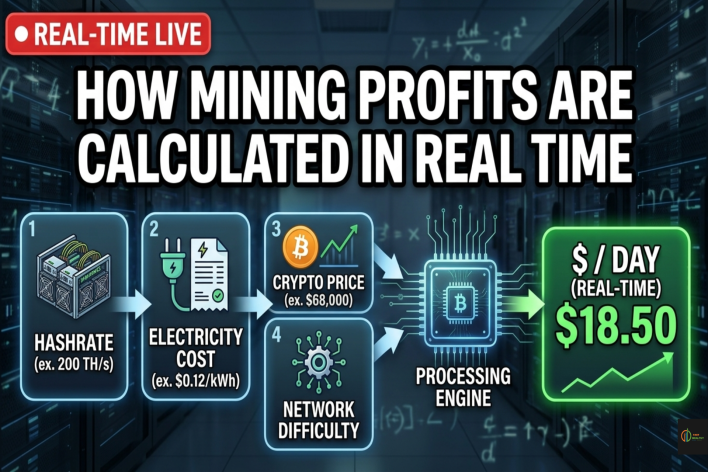
How Mining Profits Are Calculated in Real Time
Cryptocurrency mining has become one of the most popular ways to earn digital assets. Many people hear that miners generate daily income, but they often do not understand how mining profits are actually calculated. The truth is that mining profitability is not fixed. It constantly changes depending on several technical and economic factors. These include hash rate, network difficulty, electricity costs, mining hardware efficiency, and the current market value of the cryptocurrency being mined.
Understanding how these elements work together is essential for anyone interested in cryptocurrency mining. Modern mining platforms and analytics systems calculate profits in real time by analyzing these variables and updating earnings estimates instantly.
This guide explains how mining profits are calculated, what factors influence mining income, and how real-time mining calculations work.
Understanding Cryptocurrency Mining
Cryptocurrency mining is the process of verifying transactions on a blockchain network and adding them to a distributed ledger. In proof-of-work blockchains, miners use powerful computing devices to solve complex mathematical problems. When a miner successfully solves the problem, a new block is added to the blockchain and the miner receives a reward in cryptocurrency.
These rewards serve as the incentive that keeps blockchain networks secure and operational. Mining rewards generally come from two sources. The first is the block reward, which is newly generated cryptocurrency. The second is transaction fees paid by users who want their transactions processed and confirmed.
The combination of these rewards forms the total revenue that miners earn.
What Mining Profitability Really Means
Mining profitability refers to the total income a miner earns after subtracting all operating expenses. Mining requires significant resources, including specialized hardware and electricity. As a result, profitability depends on whether the value of the mined cryptocurrency exceeds the costs of running the mining equipment.
The basic concept of mining profitability can be understood with a simple formula. Mining profit is calculated by subtracting total operational costs from total mining revenue. If the revenue generated from mining is greater than the total cost of electricity, hardware depreciation, and mining pool fees, the operation is profitable.
Because several variables influence both revenue and cost, profitability can fluctuate frequently.
The Importance of Hash Rate
One of the most important factors in mining profitability is hash rate. Hash rate refers to the total computational power used to solve cryptographic puzzles during the mining process. It represents how many calculations a mining device can perform per second.
Higher hash rates increase the chances of successfully mining blocks and receiving rewards. For example, a mining machine capable of performing trillions of calculations per second has a much higher probability of solving the mathematical puzzle than a less powerful machine.
However, higher hash rate machines also tend to consume more electricity and are more expensive to purchase. This creates a balance between performance and operational cost.
Network Difficulty and Its Impact
Mining difficulty is another crucial factor that affects profitability. Blockchain networks automatically adjust the difficulty level of mining to ensure that blocks are produced at a consistent rate. When more miners join the network and the total computing power increases, the difficulty rises.
As difficulty increases, miners must perform more calculations to find the correct solution. This means that even if a miner's hash rate stays the same, the amount of cryptocurrency they earn may decrease if the network becomes more competitive.
Difficulty adjustments help maintain the stability of the blockchain but also create constant changes in mining profitability.
Electricity Costs in Mining
Electricity is one of the largest ongoing expenses in cryptocurrency mining. Mining machines run continuously, often twenty-four hours a day. High-performance mining hardware can consume thousands of watts of power.
Because of this, the cost of electricity plays a major role in determining whether mining is profitable. Miners located in areas with cheap electricity often have a competitive advantage over those operating in regions with higher energy costs.
Large mining operations frequently establish data centers in locations where electricity is inexpensive and cooling conditions are favorable. This allows them to reduce operational costs and increase overall profitability.
Hardware Investment and Efficiency
Mining requires specialized hardware designed specifically for solving cryptographic algorithms. Over the years, mining technology has evolved significantly. Early cryptocurrency miners used standard computers, but modern mining operations rely on highly specialized machines known as ASIC miners.
These devices are designed to perform a specific type of calculation extremely efficiently. While they offer very high performance, they can also be expensive.
Hardware efficiency plays a major role in profitability. Efficient mining machines produce higher hash rates while consuming less electricity. This improves the ratio between energy consumption and mining output, leading to higher potential profits.
However, mining hardware also depreciates over time. As newer and more powerful machines enter the market, older equipment may become less competitive.
Mining Pools and Shared Rewards
Most individual miners do not mine alone. Instead, they join mining pools. A mining pool is a group of miners who combine their computing power to increase their chances of successfully mining a block.
When the pool mines a block, the reward is distributed among all participants according to their contribution to the total hash rate. Mining pools provide more consistent earnings compared to solo mining because rewards are shared more frequently.
Pools typically charge a small fee for providing their service. This fee is usually a small percentage of the mining rewards.
How Real-Time Mining Calculations Work
Mining profits are calculated in real time using advanced software systems that track blockchain network data. These systems constantly monitor several key variables such as cryptocurrency price, network difficulty, total network hash rate, block rewards, and transaction fees.
Whenever one of these variables changes, the mining platform automatically updates the profitability estimate. For example, if the price of a cryptocurrency increases, the value of the mined coins increases as well. This immediately raises the estimated profit.
Similarly, if mining difficulty rises because more miners join the network, the expected earnings may decrease. Real-time calculation systems help miners stay informed about their current earnings and adjust their strategies accordingly.
Example of a Mining Profit Calculation
To better understand how mining profits are calculated, imagine a miner using a machine capable of producing one hundred terahashes per second. This machine consumes around three thousand watts of electricity.
If the daily mining revenue generated by the machine is thirty dollars and the electricity cost per day is eight dollars, the miner’s daily profit would be twenty-two dollars after paying for electricity.
However, this figure is not permanent. If the cryptocurrency price increases, the revenue may rise. If electricity prices increase or mining difficulty rises, the profit may decrease.
Break-Even Analysis in Mining
Another important concept in mining is the break-even point. Mining hardware can be expensive, so miners often calculate how long it will take to recover their initial investment.
If a miner purchases a machine for several thousand dollars and earns a fixed amount per day in profit, the break-even period represents the number of days required to earn back the original cost of the hardware.
Once the break-even point is reached, any additional mining revenue becomes net profit.
Why Mining Profitability Changes Constantly
Mining profits are constantly changing because several variables fluctuate over time. Cryptocurrency prices are highly volatile and can change within minutes. Network difficulty adjustments also occur regularly as miners enter or leave the network.
Transaction fees can increase during periods of high network activity, temporarily boosting mining rewards. At the same time, improvements in mining hardware technology may increase competition within the network.
Because all these factors interact with each other, mining profitability must be calculated dynamically rather than using fixed numbers.
Cloud Mining and Profit Monitoring
Cloud mining has become an alternative method for people who want to participate in mining without purchasing hardware. In cloud mining, users rent computing power from remote data centers that operate mining equipment.
Cloud mining platforms provide dashboards where users can monitor their earnings, track mining performance, and see estimated profits based on current network conditions.
This allows individuals to participate in cryptocurrency mining without managing physical equipment or paying for electricity directly.
Risks Associated With Mining
While mining can be profitable, it is not without risks. Cryptocurrency prices can drop suddenly, reducing the value of mined coins. Mining difficulty can increase, which lowers the amount of cryptocurrency miners receive for the same amount of work.
Hardware can also become outdated as newer and more efficient machines are released. In addition, regulatory changes in certain regions may impact mining operations.
Because of these factors, successful miners carefully analyze costs, market conditions, and technological developments before making investments.
The Future of Mining Profit Calculations
As blockchain technology evolves, mining systems are becoming more advanced and efficient. Modern mining platforms already use sophisticated analytics tools that provide real-time profitability tracking.
Future mining operations may rely more heavily on renewable energy sources, advanced cooling systems, and highly efficient mining hardware. These innovations could reduce operating costs and improve overall profitability.
Despite changes in technology and market conditions, mining will remain a fundamental component of many blockchain networks.
Conclusion
Mining profitability depends on multiple interconnected factors, including hash rate, electricity cost, network difficulty, mining hardware efficiency, and the market value of the cryptocurrency being mined. Because these variables change frequently, mining platforms use real-time calculations to estimate profits continuously.
Understanding how mining profits are calculated helps miners make informed decisions about hardware investments, energy usage, and mining strategies. By carefully monitoring these variables and adapting to changing market conditions, miners can improve their chances of maintaining profitable operations.
Watch the Video
If you would like a quick visual explanation of how mining profits are calculated in real time, watch the video below.